Neurofeedback & EEG Headbands: Brain Training Science Explained

From clinical neurofeedback to consumer headbands — what the technology can and cannot do for focus, stress, and performance

State of the Technology: Clinical neurofeedback has 60 years of research behind it and FDA clearance for ADHD (Neurcore). Consumer EEG headbands have genuine biofeedback utility for meditation and stress training, but are not equivalent to clinical-grade systems. Understanding the difference is critical for setting expectations.

What Is Neurofeedback?

Neurofeedback is a form of biofeedback that uses real-time electroencephalography (EEG) to measure brainwave activity and provide immediate feedback — typically as audio, visual, or haptic signals — allowing users to learn to voluntarily modulate their own brain states.

The core mechanism is operant conditioning: when your brain produces a target brainwave pattern (e.g., increased alpha waves during relaxation, or decreased theta in frontal regions associated with ADHD), the feedback system rewards you with a positive signal. Over time, the brain learns to produce more of the desired pattern — a process called "brain state regulation."

Understanding Brainwaves

EEG measures electrical activity produced by synchronized firing of neurons, classified by frequency:

Wave Frequency Associated States Training Goal
Delta 0.5–4 Hz Deep sleep, unconsciousness Reduce in waking states for focus
Theta 4–8 Hz Drowsiness, daydreaming, creativity Reduce (ADHD) or increase (meditation)
Alpha 8–12 Hz Relaxed alertness, eyes-closed rest Increase for calm focus and anxiety reduction
SMR 12–15 Hz Calm body, focused mind Increase for relaxed performance state
Beta 13–30 Hz Active thinking, focus, anxiety Modulate: increase for focus, decrease for anxiety
Gamma 30–100 Hz High cognition, binding, insight Increase for peak cognitive performance

Clinical Neurofeedback: The Evidence Base

ADHD

The strongest evidence for neurofeedback exists for ADHD treatment. Children with ADHD typically show excess theta (slow waves) and deficient beta (fast waves) in prefrontal regions — a pattern called "cortical underarousal." Neurofeedback protocols targeting theta/beta ratio reduction have been studied in over 50 randomized controlled trials.

A 2021 meta-analysis in Neuroscience & Biobehavioral Reviews found significant effects on inattention and impulsivity comparable to behavioral therapy, with effects persisting 6–12 months post-treatment — suggesting genuine neuroplastic changes rather than temporary conditioning.

PTSD & Anxiety

Alpha-theta neurofeedback — training deeper, more meditative brainwave states — has been studied for PTSD, showing reductions in hypervigilance and intrusive thoughts. A 2020 Cochrane review found promising but insufficiently powered evidence; ongoing large-scale RCTs are in progress.

Peak Performance

Elite military units (US Special Forces), professional sports teams, and performing arts organizations have used neurofeedback for performance enhancement. Research with elite archers and golfers found that quiet mind states (characterized by alpha-theta activity) immediately precede peak performance moments — and neurofeedback training accelerates access to these states (Hatfield & Hillman, 2001).

Consumer EEG Headbands: Honest Assessment

How They Work

Consumer headbands use dry EEG electrodes (typically 2–7 sensors) that sit on the forehead and behind the ears. Clinical EEG uses 19–256 wet-gel electrodes covering the full scalp. The signal quality difference is substantial: consumer devices capture broad frontal activity and can reliably detect large-scale shifts (eyes-open vs. closed, relaxed vs. active), but cannot perform the precise spatiotemporal mapping of clinical systems.

What They Can Do Well

  • Meditation biofeedback: Real-time feedback during meditation about mental state (calm vs. active) — useful for novices learning to distinguish mental states
  • Stress monitoring: Tracking relative change in frontal alpha/theta ratio as a proxy for stress levels across the day
  • Sleep stage tracking: Some devices (Muse S) use EEG for more accurate sleep stage detection than wrist-worn optical sensors
  • Engagement/focus trends: Longitudinal tracking of cognitive engagement patterns during work sessions

What They Cannot Do

  • Diagnose or treat any medical condition
  • Replace clinical-grade neurofeedback for ADHD, PTSD, or epilepsy
  • Provide high-spatial-resolution brain mapping
  • Reliably measure gamma waves (contaminated by muscle artifact at consumer electrode quality)

The Muse Headband: Detailed Review

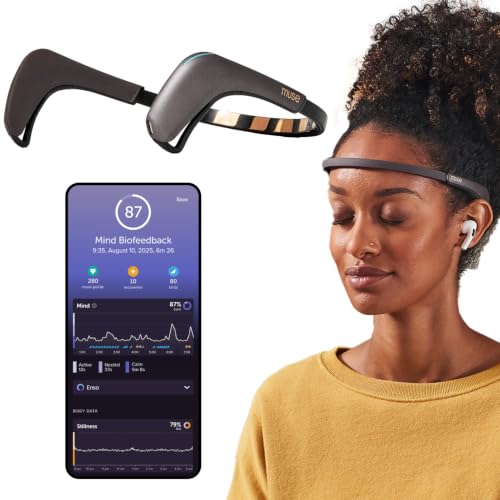
Muse (InteraXon) is the most validated consumer EEG device, with multiple independent peer-reviewed studies examining its accuracy and the efficacy of its meditation training protocol.

Hardware: 4 EEG sensors (AF7, AF8, TP9, TP10), 2 reference sensors, 500 Hz sampling rate
Validated accuracy: Good agreement with clinical EEG for alpha power and eyes-open/closed discrimination; acceptable for meditation state detection
Evidence: Bhayee et al. (2016) found 8-week Muse-guided meditation improved sustained attention compared to unguided meditation. Tarrant et al. (2020) found EEG changes in experienced meditators consistent with deeper meditative states.
Models: Muse 2 (basic, $199); Muse S (sleep EEG + softer design, $329)

Other Notable Devices

Neurosity Crown

Higher-end device targeting developers and researchers — 8 channels, higher sample rate, open API. Designed for focus tracking and brain-computer interface applications. Better signal quality than Muse but significantly more expensive (~$1,000). Best for technically sophisticated users who want to build custom applications.

Dreem 3 (Rhythm)

Medical-grade sleep EEG headband that received FDA breakthrough device designation. 6 EEG channels, validated against clinical polysomnography. Designed for sleep research and clinical monitoring rather than general consumer use. Primarily available through clinical partnerships.

Neuroptimal

Clinical neurofeedback system that uses a proprietary "non-linear" training algorithm — different from traditional protocol-based neurofeedback. Available through practitioners. Strong anecdotal support; less peer-reviewed evidence than traditional neurofeedback protocols. Sessions typically $100–150 per session.

Protocol-Based Home Neurofeedback

For those interested in more serious neurofeedback beyond consumer headbands, several platforms now offer protocol-based neurofeedback at home using validated equipment:

  • Myndlift: Uses the Muse headband but adds clinician oversight, structured protocols (ADHD, anxiety, peak performance), and remote monitoring by licensed neurofeedback practitioners. Bridges consumer and clinical applications.
  • Neuropeak Pro: Professional neurofeedback platform used by sports teams and executives; requires initial assessment and practitioner guidance.

What to Expect: Timelines and Realistic Outcomes

  • Meditation biofeedback (Muse): Most users notice improved ability to recognize and return to calm states within 2–4 weeks of daily 10-minute sessions
  • Clinical ADHD neurofeedback: Standard protocol is 40 sessions; most practitioners recommend 20 as a minimum to assess response
  • Peak performance training: 20–40 sessions for meaningful skill transfer; effects are typically state-dependent (need continued practice to maintain)

Recommended Devices

Muse S Headband (Gen 2)

Best Consumer EEG

The Muse S is the most scientifically validated consumer EEG device — validated in peer-reviewed research, with comfortable soft fabric construction for sleep use, real-time meditation feedback, and optional Go-to-Sleep guidance that reads brainwave activity and adapts audio accordingly. The most evidence-backed starting point for consumer neurofeedback and meditation biofeedback.

Shop Muse S on Amazon

Muse 2 Headband

Budget-Friendly

The Muse 2 offers the same core EEG meditation biofeedback as the Muse S at a lower price point — adding heart rate, breath, and body movement sensors alongside EEG. Less comfortable for sleep use than the Muse S but excellent for seated meditation sessions. The most affordable entry into validated EEG biofeedback.

Shop Muse 2 on Amazon

Neurosity Crown

Developer/Researcher

The Neurosity Crown targets developers, researchers, and advanced users with 8 EEG channels, open SDK, and focus classification algorithms. Designed for building brain-computer interface applications, focus monitoring during work, and custom neurofeedback protocols. Higher signal fidelity than Muse at a significantly higher price (~$999).

Shop EEG Headsets on Amazon

EmWave2 (HeartMath) — HRV Coherence Training

Complementary Tool

While not an EEG device, the HeartMath EmWave2 measures heart rate variability coherence — a state associated with calm, focused performance similar to alpha brainwave states. Extensive clinical research (250+ peer-reviewed studies) validates HRV coherence training for stress, anxiety, and performance. Often used alongside EEG neurofeedback in clinical settings.

Shop HeartMath EmWave2 on Amazon

Is It Worth It?

Consumer EEG headbands are most valuable as enhanced meditation tools — providing objective feedback that helps novice meditators recognize and sustain calm states faster than unguided practice. For ADHD, anxiety, or clinical applications, they are not substitutes for clinical neurofeedback with a qualified practitioner.

If you already meditate and want a technological edge — or struggle to establish a consistent meditation practice and find biofeedback motivating — devices like the Muse offer genuine, evidence-backed utility. Approach the broader claims of "peak brain performance" or "cognitive enhancement" with appropriate skepticism and realistic expectations.

Best Starting Point: Try the Muse 2 for 60 days of daily 10-minute sessions before investing in more sophisticated systems. If you find the biofeedback genuinely useful and motivating, then explore clinical neurofeedback with a practitioner for protocol-based training with stronger evidence.

Conclusion

Neurofeedback represents one of the most scientifically grounded forms of brain self-regulation available. Clinical neurofeedback for ADHD is a legitimate therapeutic intervention with decades of evidence. Consumer EEG headbands offer real utility for meditation biofeedback and stress awareness — with appropriate expectations about what they can and cannot deliver. As sensor technology and AI-driven analysis improve, the gap between consumer and clinical systems continues to narrow.