⚡ As an Amazon Associate, VitalGuide earns from qualifying purchases. This helps us keep the site free.

Aromatherapy & Essential Oils Guide 2026: Science, Benefits & Best Products

By the VitalGuide Wellness Team · May 2026 · 14 min read

Aromatherapy occupies an unusual position in wellness — surrounded by both genuine scientific evidence and considerable overclaiming. The truth lies between the skeptics who dismiss it entirely and the enthusiasts who claim essential oils can cure disease. For specific applications — particularly stress reduction, sleep quality, and cognitive performance — aromatherapy has a real and growing evidence base. Understanding what the research actually shows allows you to use essential oils intelligently, rather than based on marketing or folklore.

This guide covers the neuroscience of how scent works, the essential oils with the strongest clinical evidence, how to use them safely and effectively, and the best diffusers and essential oil brands available in 2026.

The Science of Scent: How Aromatherapy Works

The Olfactory-Limbic Connection

The olfactory system has a uniquely direct pathway to the brain's limbic system — the network of structures governing emotion, memory, and arousal. Unlike other senses, which relay information through the thalamus, smell signals travel directly to the amygdala (emotion processing), hippocampus (memory formation), and hypothalamus (autonomic function regulation). This anatomical shortcut explains why scent triggers emotional responses faster and more powerfully than any other sensory input — and why aromatherapy can produce measurable physiological effects.

Inhalation vs. Topical vs. Oral

Essential oils can be used in three main ways, each with different mechanisms:

  • Inhalation (diffusion): Volatile aromatic compounds are inhaled, bind to olfactory receptors, and trigger direct limbic signaling. Effects are rapid (seconds to minutes) but relatively short-lasting. Best for acute stress, focus, and mood enhancement.
  • Topical application: Essential oils can be absorbed through the skin when diluted in a carrier oil. Absorption rates vary by compound and skin location. Effects from topical use combine local skin effects (anti-inflammatory, antimicrobial) with some absorption. Must always be diluted — pure essential oils cause skin irritation and sensitization.
  • Oral (ingestion): Some essential oil preparations are used orally (e.g., enteric-coated peppermint oil for IBS). This is distinct from "drinking" essential oils — most undiluted essential oils are toxic when ingested. Only use oral EO preparations specifically formulated for this purpose.

Evidence-Based Essential Oils: What the Research Shows

Lavender (Lavandula angustifolia) — The Most Evidence-Backed Essential Oil

Best for: Anxiety, sleep quality, stress reduction

Lavender is by far the most studied essential oil in clinical research, with over 30 randomized controlled trials. Key findings:

  • Anxiety: A 2014 meta-analysis in Phytomedicine confirmed that lavender inhalation significantly reduces anxiety in multiple populations (preoperative, ICU, dental). A standardized oral lavender preparation (Silexan, 80 mg/day) demonstrated efficacy comparable to lorazepam (a benzodiazepine) for generalized anxiety disorder in a double-blind RCT.
  • Sleep: Lavender inhalation before sleep has been shown to reduce sleep latency, increase deep (slow-wave) sleep time, improve morning alertness, and reduce nighttime waking in multiple studies across college students, elderly patients, and post-partum women.
  • Mechanism: Linalool and linalyl acetate — the primary active compounds in lavender — modulate GABA receptors, inhibit calcium channels, and reduce sympathetic nervous system activity.

How to use: Diffuse 3–5 drops for 30–60 minutes before bed. Add 2–3 drops to a cotton ball and place near pillow. Dilute 2% in carrier oil for topical use on pulse points.

Peppermint (Mentha piperita) — Energy, Focus & Athletic Performance

Best for: Mental alertness, headache relief, workout performance

  • Cognitive performance: Inhalation of peppermint oil improves sustained attention, memory, and reaction speed in multiple controlled studies. The effect appears to involve arousal through the trigeminal nerve and limbic stimulation.
  • Athletic performance: A remarkable 2013 study in the Journal of the International Society of Sports Nutrition found that ingestion of 0.05 ml of peppermint oil in 500 ml water before exercise significantly improved VO2 max, ventilation capacity, and grip strength — suggesting peppermint affects respiratory muscle relaxation and performance.
  • Headache relief: Topical peppermint oil (10% dilution in ethanol applied to forehead and temples) was as effective as 1,000 mg acetaminophen for tension headaches in a double-blind trial.

How to use: Diffuse during study or work for focus. Apply 1–2 drops diluted in carrier oil to temples for headaches (keep away from eyes).

Eucalyptus (Eucalyptus globulus) — Respiratory Support & Mental Clarity

Best for: Nasal congestion, respiratory wellness, mental clarity

Eucalyptus oil contains 1,8-cineole (eucalyptol), which has well-documented anti-inflammatory, bronchodilatory, and mucolytic effects on the respiratory tract. Clinical evidence supports its use for sinusitis, chronic obstructive pulmonary disease, and bronchitis symptom relief. Inhalation also produces subjective feelings of mental clarity and energy, making it useful as an invigorating diffuser oil during the day. Note: Keep away from children under 2 years old — eucalyptol is toxic to young children at high concentrations.

Bergamot (Citrus bergamia) — Mood Elevation & Anxiety

Best for: Depression-adjacent mood, stress

Bergamot essential oil contains linalool and limonene — compounds shared with lavender that modulate GABA and serotonin systems. Multiple studies show bergamot inhalation reduces cortisol, heart rate, and self-reported anxiety. A 2019 study found bergamot aromatherapy significantly reduced anxiety and fatigue in elementary school teachers. It also produces a distinctive mood-elevating effect distinct from lavender's calming profile — more uplifting and less sedating. Note: Bergamot is phototoxic when applied to skin; avoid sun exposure after topical use unless using bergapten-free (FCF) bergamot oil.

Frankincense (Boswellia sacra) — Meditation, Grounding & Anti-Inflammation

Best for: Mindfulness practice, stress, skin health

Frankincense oil contains incensole acetate and alpha-pinene, which research suggests activate TRPV3 channels in the brain — producing warm, grounding emotional states associated with spiritual and meditative practices. A 2008 study in the FASEB Journal identified incensole acetate as psychoactive, reducing anxiety and depression in animal models. Traditionally used across cultures for prayer and meditation environments — there appears to be a neurobiological basis for this practice. Topically, frankincense promotes skin regeneration and has mild anti-inflammatory properties.

Tea Tree (Melaleuca alternifolia) — Antimicrobial & Skin Health

Best for: Skin blemishes, wound care, household cleaning

Tea tree oil is one of the most clinically validated essential oils for antimicrobial applications. Multiple trials confirm its efficacy against acne (comparable to 5% benzoyl peroxide with fewer side effects), nail fungus, and wound healing. It is a legitimate alternative to harsh chemical antiseptics for minor skin applications. Important: Never ingest. Toxic to pets — particularly cats.

Essential Oil Safety: Critical Rules

  • Always dilute for skin use: Most essential oils cause irritation and sensitization at full strength. Standard dilution: 2% for adults (roughly 12 drops per ounce of carrier oil). Use 1% or less for facial application, elderly, or children.
  • Never ingest without specific medical-grade formulation: Aromatherapy-grade essential oils are not intended for internal use.
  • Perform patch test: Apply diluted oil to inner wrist and wait 24 hours before widespread topical use.
  • Phototoxic oils: Citrus oils (bergamot, lemon, lime, grapefruit) cause severe sun reactions on skin. Avoid sun exposure for 12–24 hours after topical application, or use steam-distilled (not cold-pressed) varieties.
  • Pets: Several oils are toxic to cats and dogs. Keep pets in well-ventilated areas during diffusion. Avoid tea tree, eucalyptus, and peppermint around cats.
  • Pregnancy: Many essential oils are contraindicated during pregnancy. Consult your OB before use.

Best Aromatherapy Diffusers 2026

1. URPOWER 500ml Ultrasonic Diffuser

Best Overall Value — Large Capacity, Quiet Operation

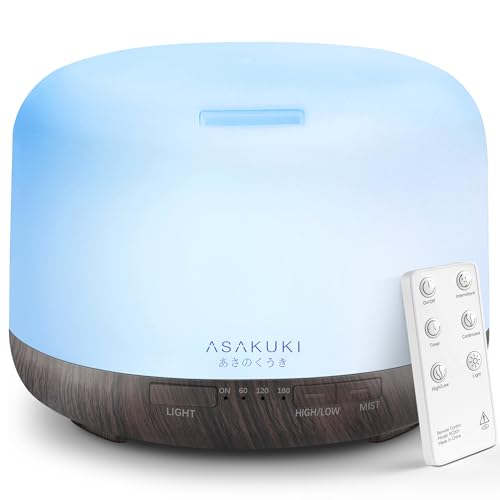
Ultrasonic diffusers use water and ultrasonic vibrations to create a cool mist — preserving the volatile compounds in essential oils better than heat-based methods. The URPOWER 500ml has earned its status as one of the best-reviewed diffusers on Amazon through consistent quality, quiet operation (under 36 dB — whisper quiet), an 8–10 hour run time per fill, optional ambient lighting, and an auto shut-off when water runs low. The large capacity is ideal for bedrooms, living rooms, and offices. For most users, this is the best starting diffuser — effective, durable, and reasonably priced.

Pros: Large 500ml tank, 8–10 hour runtime, very quiet, auto shut-off, multiple mist settings, LED lighting.

Cons: Requires regular cleaning to prevent mold; plastic construction.

Best for: Bedrooms, living rooms, first-time diffuser buyers.


2. Vitruvi Stone Diffuser

Best Premium Option — Elegant Design, Quality Mist

The Vitruvi Stone Diffuser is the aesthetically premium choice in the diffuser category — a porcelain and ceramic construction that functions as a home decor piece as much as a wellness device. The ultrasonic mechanism is effective, quiet, and produces fine mist. Three run time settings (1, 3, 7 hours). What sets Vitruvi apart is the material — non-plastic, non-BPA construction means no plastic off-gassing with heated water, and the design is genuinely beautiful in a way few diffusers are. More expensive than basic options, but worth it for those who care about aesthetics.

Pros: Beautiful ceramic design, non-plastic construction, quiet, quality mist output, multiple runtime settings.

Cons: Higher price; smaller water tank (100ml) limits runtime to ~7 hours.

Best for: Home aesthetics-focused buyers, bedrooms, desks, as a gift.


3. InnoGear Upgraded 150ml Diffuser

Best Compact Option — Office & Travel

The InnoGear 150ml diffuser is compact enough for a desk, nightstand, or travel bag while being fully functional — ultrasonic mist generation, multiple settings, auto shut-off. The smaller water tank means more frequent refills (3–6 hours), but the compact size is exactly what's needed for personal workspace use. One of the most popular desk diffusers on Amazon with thousands of verified reviews. At a low price, it's an excellent second diffuser for an office after you've already set up a larger unit at home.

Pros: Compact, very affordable, quiet, good for desk or small spaces, widely available.

Cons: Small tank requires more frequent refilling; less mist output than larger models.

Best for: Office desks, small spaces, travel, secondary diffuser.

Best Essential Oils 2026: Top Brands

1. Plant Therapy Essential Oils

Best Overall Brand — GC/MS Tested, Excellent Value

Plant Therapy is the most recommended essential oil brand for quality at reasonable prices. Every batch is GC/MS tested (gas chromatography/mass spectrometry) — the gold standard for verifying oil purity, composition, and the absence of adulterants. Results are publicly posted on their website for any lot number. They offer KidSafe labeling, a full range of single oils and blends, and responsive customer service. The best starting point for building an essential oil collection without the premium pricing of doTERRA or Young Living.

Pros: GC/MS tested with public results, KidSafe labeling, excellent value, wide selection.

Cons: Not as widely known as MLM brands; fewer exotic or rare oil offerings.

2. Rocky Mountain Oils

Best for Purity-Focused Buyers

Rocky Mountain Oils (RMO) provides GC/MS testing, quality sourcing from established growers, and transparent supply chain documentation. They have a strong reputation in the essential oil community for authenticity and purity standards comparable to Plant Therapy. A good alternative or complementary brand for those building a varied collection.

Pros: GC/MS tested, transparent sourcing, strong community reputation, good selection.

Cons: Mid-range pricing; fewer value bundle options than Plant Therapy.

Aromatherapy Protocols: Practical Applications

Sleep Protocol

  • 30 minutes before bed: diffuse lavender (3 drops) + cedarwood (2 drops) + vetiver (1 drop)
  • Optional: apply diluted lavender oil to pulse points (wrists, temples)
  • Consistent use for 1–2 weeks produces strongest conditioning effect (scent-sleep association)

Stress & Anxiety Relief

  • Diffuse: lavender (3 drops) + bergamot (2 drops) for 30–60 minutes
  • Personal inhaler: add lavender + frankincense to a personal aromatherapy inhaler stick for on-the-go use

Focus & Productivity

  • Diffuse peppermint (2 drops) + rosemary (2 drops) + lemon (2 drops) during work sessions
  • Switch to neutral or no scent during breaks to maintain stimulus association

The Bottom Line

Aromatherapy works best when you understand what the evidence actually supports: meaningful effects on stress, sleep, and mood rather than medical cures. The strongest evidence exists for lavender (anxiety and sleep), peppermint (focus and headache), and eucalyptus (respiratory support). Choose GC/MS tested oils from brands like Plant Therapy or Rocky Mountain Oils, use a quality ultrasonic diffuser, and dilute all oils before skin contact.

For complementary wellness practices, see our guides on mindfulness and meditation, how to improve your sleep, and breathwork techniques.

Disclaimer: VitalGuide participates in the Amazon Associates program. Links to Amazon products on this page are affiliate links — we may earn a commission if you purchase through them, at no extra cost to you. This article is for informational and educational purposes only. Aromatherapy is a complementary wellness practice and not a substitute for medical treatment. Consult your healthcare provider regarding any health conditions.

Related Articles

Browse all Wellness guides →

Get Weekly Wellness Tips

Join 50,000+ readers who get our weekly roundup of the best health products, deals, and evidence-based wellness advice.

👩‍⚕️

Reviewed by

Sarah Mitchell, MS, RDN

Sarah is a Registered Dietitian Nutritionist with a Master's in Nutritional Sciences and over 12 years of clinical experience. She leads VitalGuide's editorial review process, ensuring every recommendation reflects current scientific evidence.

View full profile →