The Biology of Light and Mood
Light is the primary zeitgeber — the external cue that entrains the body's circadian clock. Specialized photoreceptors in the retina called intrinsically photosensitive retinal ganglion cells (ipRGCs) contain melanopsin — a photopigment maximally sensitive to short-wavelength blue light (~480 nm). These cells project directly to the suprachiasmatic nucleus (SCN), the master circadian pacemaker in the hypothalamus.
The SCN orchestrates downstream timing of cortisol secretion, melatonin production, body temperature rhythm, and dozens of other biological processes. When morning light input to the SCN is insufficient — due to short winter days, indoor living, or late rising — the entire circadian system drifts, and mood, energy, and sleep architecture deteriorate accordingly.
In people with genetic predisposition to seasonal affective disorder (SAD), this circadian disruption combines with dysregulated serotonin transporter activity and exaggerated melatonin duration to produce clinical depression every autumn and winter.
What Is SAD? Who Gets It?
Seasonal Affective Disorder (SAD) is a subtype of major depressive disorder with a seasonal pattern — onset in fall, remission in spring, for at least two consecutive years. It affects an estimated 1–6% of the general population (higher in northern latitudes) and a further 10–20% experience "subsyndromal SAD" (winter blues) — clinically significant but not meeting full diagnostic criteria.
SAD symptoms include:
- Persistent low mood, fatigue, loss of motivation
- Increased sleep duration with persistent daytime sleepiness
- Increased appetite — particularly carbohydrate cravings
- Social withdrawal
- Difficulty concentrating
- Weight gain over winter months
SAD is more common in women (4:1 female:male ratio), younger adults, and those living above 45° latitude — though it occurs at all latitudes. The mechanism involves a delayed circadian phase in winter, overproduction of serotonin transporter (SERT) that clears serotonin too rapidly, and prolonged melatonin secretion duration.
How Light Therapy Works
A bright light box delivers high-intensity white or blue-enriched light — typically 10,000 lux — directly to the retinal ipRGCs. This input to the SCN effectively simulates the brightness of outdoor morning sun (which reaches 10,000–100,000 lux) even indoors. The therapeutic effects operate through:
- Circadian phase advancement: Morning bright light shifts the circadian clock earlier, correcting the delayed phase characteristic of SAD and winter circadian drift
- Serotonin transporter regulation: Bright light reduces SERT activity, increasing synaptic serotonin — the same end-result as SSRIs but via a different mechanism
- Melatonin suppression: Morning light suppresses residual melatonin, reducing the prolonged melatonin window that contributes to winter fatigue
- Cortisol rhythm normalization: Properly timed morning light advances the cortisol awakening response, improving morning alertness and energy
Clinical Evidence: Light Therapy vs Antidepressants
The evidence for light therapy in SAD is exceptional — arguably stronger than for any individual antidepressant at comparable doses.
The Landmark 2015 JAMA Psychiatry RCT
A rigorous 2015 RCT published in JAMA Psychiatry (Lam et al.) directly compared 10,000 lux light therapy, fluoxetine (Prozac), light therapy + fluoxetine, and placebo in 122 adults with SAD. Results after 8 weeks:
- Light therapy alone: 50% remission rate
- Fluoxetine alone: 33% remission rate
- Light + fluoxetine: 76% remission rate
- Placebo: 33% remission rate
Light therapy outperformed antidepressant medication as monotherapy — a finding consistent with earlier Cochrane meta-analyses showing light therapy equivalent or superior to antidepressants for SAD with faster onset of action (1–2 weeks vs 4–6 weeks for antidepressants).
Non-Seasonal Depression
A 2016 JAMA Psychiatry RCT (Lam et al., same group) found bright light therapy significantly more effective than placebo for non-seasonal major depression — with the combination of light therapy + fluoxetine producing the largest effect size. Light therapy is no longer solely a seasonal intervention.
The Protocol: How to Use a Light Therapy Box
Timing
Morning use is essential. Light therapy must be used within 30–60 minutes of waking — this is when ipRGC signaling has the greatest circadian effect. Evening light therapy delays the circadian clock (the opposite of what's needed) and can worsen sleep.
Duration
- 10,000 lux: 20–30 minutes per session
- 5,000 lux: 45–60 minutes per session
- 2,500 lux: 2 hours per session (impractical for most)
Start with 10–15 minutes and increase gradually if side effects occur. Most people require 20–30 minutes at 10,000 lux for full therapeutic benefit.
Distance and Eye Position
- Sit approximately 40–60 cm (16–24 inches) from the light box
- Light should fall on the eyes — look toward (not directly at) the light, with eyes open
- Can read, eat breakfast, or work during exposure
- Do not wear sunglasses or UV-blocking lenses during treatment
When to Expect Results
Most people notice initial response within 2–4 days; full antidepressant effect builds over 1–2 weeks. Continue throughout the at-risk season (typically October–March in northern hemisphere). Do not stop abruptly when feeling better — taper by reducing frequency rather than stopping cold.
Light Specifications: What to Look For
- Minimum 10,000 lux at the rated distance — verify lux output, not just wattage
- UV-filtered: Therapeutic effect comes from visible light, not UV; UV adds risk without benefit
- Color temperature: 5,000–6,500K (cool white or daylight); blue-enriched is more efficient but may cause more eye strain
- Screen size: Larger screen (>175 cm²) allows easier positioning and longer viewing distance
- No flicker: LED or fluorescent — avoid incandescent SAD lamps
Side Effects and Contraindications
Light therapy is well-tolerated with mild, transient side effects in ~20% of users:
- Headache (usually resolves with reduced session time)
- Eye strain or visual disturbance
- Agitation or irritability at high initial doses — start low
- Nausea (rare)
Contraindications/cautions:
- Bipolar disorder: Light therapy can trigger hypomanic or manic episodes — requires psychiatric supervision
- Retinal conditions: Macular degeneration, diabetic retinopathy, history of retinal surgery — consult ophthalmologist
- Photosensitizing medications: Some antibiotics (tetracyclines), lithium, St. John's Wort, and psoralens increase light sensitivity
- Lupus: Photosensitive condition — avoid
Best Light Therapy Boxes (2026)
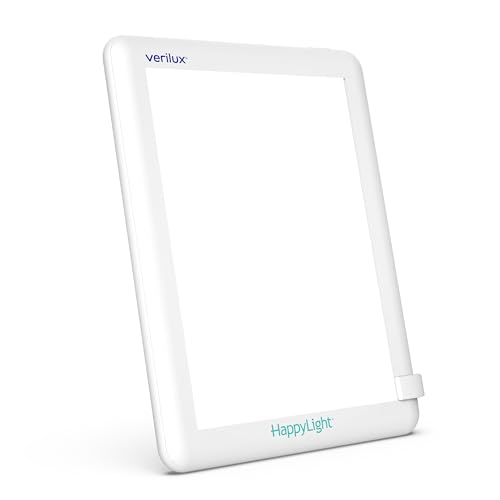
Verilux HappyLight Luxe 10,000 Lux
Editor's Pick — Best OverallVerilux is one of the original SAD lamp brands, and the HappyLight Luxe delivers a verified 10,000 lux at the rated distance with a large UV-free LED panel (264 cm²) and three color temperature settings (3,000K / 4,500K / 6,500K). The larger panel gives more flexibility in seating distance than compact devices. Adjustable brightness (50/75/100%) allows gradual adaptation. FSA/HSA eligible. Comes with a built-in timer. Consistently one of the top-rated SAD lamps for comfort and effectiveness with minimal eye strain reports.
Check Price on AmazonCarex Day-Light Classic Plus
Best Clinical-GradeThe Carex Day-Light Classic Plus is the most clinically referenced consumer SAD lamp — used in multiple academic research settings and frequently cited in clinical guidelines. Its large, tilted panel (340 cm²) positions the light above the user's line of sight, matching how the sky delivers light naturally and reducing direct glare. Delivers verified 10,000 lux at 30 cm with UV filtering. More expensive than compact alternatives but the tilted design significantly reduces eye strain during extended sessions. FSA/HSA eligible.
Check Price on AmazonCircadian Optics Lumos 2.0
Best Compact — Travel FriendlyFor those needing portability without sacrificing lux output, the Circadian Optics Lumos 2.0 delivers 10,000 lux in a compact, lightweight form factor with a sleek design that doubles as a desk lamp. Three brightness settings (2,500 / 5,000 / 10,000 lux) allow adjustment based on available time. USB-C powered — works with any USB-C charger or laptop port. More compact panels require closer positioning to achieve rated lux — follow the distance guide precisely. Best for travel or users with limited desk space.
Check Price on AmazonLight Therapy for Non-SAD Applications
Beyond SAD, morning bright light has documented benefits for:
- Jet lag: Strategically timed light exposure (and avoidance) accelerates circadian re-entrainment by up to 2x
- Shift work: Bright light during night shifts and dark therapy (blue-blocking glasses) during commute home helps maintain performance and reduce metabolic disruption
- Non-seasonal depression: As noted, 2016 RCT shows significant benefit as monotherapy and adjunct
- Cognitive performance: Morning bright light improves alertness, reaction time, and working memory acutely — regardless of SAD diagnosis
- Insomnia: Morning bright light anchors the circadian clock, improving sleep onset time and quality in people with delayed sleep phase
- Dementia care: Multiple RCTs show bright light therapy reduces agitation, improves sleep, and slows cognitive decline in Alzheimer's patients
Natural Light First
A light box is the best option when outdoor light access is limited — but outdoor morning light is substantially superior when available. Even on overcast days, outdoor light delivers 1,000–10,000 lux — far exceeding typical indoor light (100–500 lux). Spending 10–20 minutes outside within an hour of sunrise is more effective than any light box for circadian anchoring, as it also involves physical activity and full-spectrum light including wavelengths no artificial box perfectly replicates.
The Bottom Line
Light therapy for SAD has a 30+ year evidence base and is classified as a first-line treatment in clinical guidelines from the American Psychiatric Association, Canadian Network for Mood and Anxiety Treatments, and multiple European psychiatric societies. At 10,000 lux for 20–30 minutes each morning during at-risk months, it is safe, effective, fast-acting, and free of systemic side effects for most users. Anyone experiencing winter mood deterioration, persistent morning fatigue, or difficulty maintaining circadian regularity should consider it before reaching for supplements or medications.