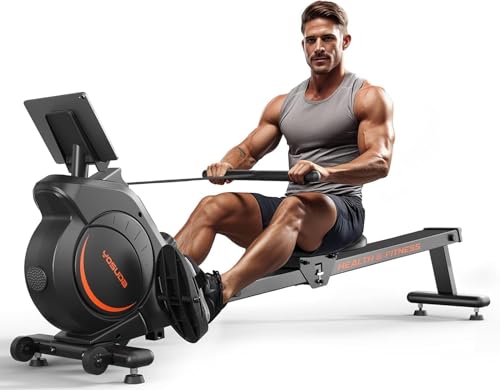
The rowing machine is one of the most complete pieces of cardio equipment available. A proper rowing stroke recruits legs (60%), core (20%), and upper body (20%), making it simultaneously a cardiovascular training tool and a full-body strength endurance movement. It's also low-impact — the hinge-and-pull mechanics generate minimal joint stress compared to running or jumping.
The category ranges from budget hydraulic machines to commercial-grade concept ergometers used in Olympic training. The resistance type fundamentally changes the training experience. Here's how to navigate the options.
Resistance Types Explained
Air Resistance (Fan/Flywheel)
A fan blade creates resistance proportional to pull speed — harder and faster means more resistance automatically. This self-scaling resistance is ideal for interval training because it responds instantly to effort changes. The Concept2 RowErg — the global standard for competitive rowing — uses air resistance. Downsides: audible fan noise (similar to a box fan on medium speed) and no precise resistance adjustment. Best for: performance training, CrossFit-style intervals, competitive rowers.
Magnetic Resistance
A magnet creates resistance against a flywheel with no physical contact — resulting in near-silent operation. Resistance is set manually or electronically in discrete levels rather than scaling with effort. The quiet operation makes magnetic rowers ideal for shared living spaces, apartments, or early-morning training. Resistance feel is different from air — smoother and consistent rather than reactive. Best for: quiet home environments, steady-state cardio, users who don't need the competitive rowing experience.
Water Resistance
A paddle moves through a tank of water, creating resistance that scales with effort similar to air resistance — but with a distinctly smooth, quiet feel that many describe as closest to on-water rowing. The sound is a pleasant water whoosh rather than fan noise. Water tanks require occasional maintenance (adding preservative tablets) and can't be transported easily. Best for: those who want a premium, realistic rowing feel with quieter operation than air.
Hydraulic/Piston
Pistons provide resistance — the most compact and affordable option. The rowing motion often isn't true to on-water mechanics (separate arm strokes rather than a unified drive), and resistance consistency is lower than other types. Best for: very limited space or very tight budgets where full-form rowing isn't the priority.
The Physiology of Rowing
A well-executed rowing stroke is a power movement — not an arm pull. The sequence is: legs drive first (pushing through the footplates), then the core opens (hinging back), then the arms pull last. The return is the reverse. This sequence ensures the largest muscle groups (quads, glutes, hamstrings) generate the primary power while the back and arms transfer it.
At 20 strokes per minute — a moderate recreational pace — a 175-pound person burns approximately 600–700 calories per hour on a rowing ergometer. At competitive rates (28–36 spm in racing pieces), the cardiorespiratory demand is extreme. A 2000-meter time trial is considered one of the most demanding aerobic tests in existence, engaging both aerobic and anaerobic systems simultaneously.
Top Rowing Machine Picks
Concept2 RowErg (Model E)
Best Overall / Industry StandardThe Concept2 RowErg is the undisputed standard for rowing performance. Used in Olympic training centers, CrossFit gyms, and collegiate rowing programs worldwide, it's the machine every rowing competition result is benchmarked against. The PM5 performance monitor tracks splits, watts, calories, heart rate, and connects to Concept2's online logbook and ErgData app. The air-resistance fan provides true effort-scaling resistance with immediate response.
Model E (taller frame) is more comfortable for users over 6'0" or with limited mobility — the seat is higher off the floor, making it easier to get on and off. The Model D (lower frame, slightly less expensive) is the choice for most athletes. Both fold vertically for storage. Durability is legendary — Concept2s from 20 years ago are still in service in gyms worldwide.
Check Price on AmazonHydrow Wave Rowing Machine
Best Connected RowerHydrow's Wave is the premium connected rowing experience — a 16-inch touchscreen delivers live and on-demand classes filmed on actual water with professional rowers. The electromagnetic resistance system adjusts automatically during guided workouts, and the Hydrow app provides structured programs, live leaderboards, and a range of cross-training content beyond rowing. The wave-form resistance profile is engineered to mimic on-water feel.
For users who want the motivation of instructor-led classes and a premium aesthetic, the Hydrow Wave is the category leader. Requires Hydrow subscription for full functionality. Quieter than air rowers — the electromagnetic system produces minimal noise. Best for those who will consistently use guided programming rather than self-directed training.
Check Price on AmazonWaterRower Natural Rowing Machine
Best Water RowerThe WaterRower is handcrafted from solid ash wood — aesthetically the most attractive rowing machine on the market and the one most likely to blend into living room or home office environments rather than look like gym equipment. The water tank provides a smooth, quiet resistance feel that scales with effort. The S4 monitor tracks time, distance, stroke rate, and calories. Storage is vertical (like Concept2), taking minimal floor space when not in use.
The WaterRower is the choice for users who prioritize aesthetics and quiet operation in a domestic environment. It's not the training tool for competitive rowers benchmarking splits — but for cardiovascular conditioning and Zone 2 training in a beautiful, quiet package, it's exceptional. Ash wood is durable and requires occasional light oiling.
Check Price on AmazonSunny Health & Fitness SF-RW5623 Magnetic Rower
Best Budget MagneticFor budget-conscious buyers who need quiet operation, the Sunny SF-RW5623 provides 8 levels of magnetic resistance, a padded seat, adjustable footrests, and an LCD monitor tracking time, count, calories, and distance — all at a fraction of the cost of premium options. It folds flat for compact storage, making it viable in small apartments. Build quality is lighter than commercial rowers but solid for moderate home use.
Best for beginners exploring rowing as a cardio modality, users training in shared spaces where noise is a concern, or those who want effective steady-state cardio without the investment of a premium machine.
Check Price on AmazonTechnique: The 4-Part Stroke Sequence
Poor rowing technique is common and leads to lower back strain. The correct sequence:
- The catch: Arms extended, shins vertical, core braced, slight forward lean — avoid hunching
- The drive: Press through legs first while keeping arms straight; when legs are nearly extended, hinge the torso back to ~11 o'clock position; then pull arms to lower ribs
- The finish: Legs flat, slight torso lean back, elbows past body, handle at lower chest
- The recovery: Arms extend first, torso comes forward, then knees bend — always reverse order of the drive
The most common mistake: pulling with the arms before the legs have fully driven. This limits power and stresses the lower back. The legs should generate 60% of the stroke power.
Programming for Rowing
- Zone 2 base building: 30–45 min at 18–20 spm and conversational effort, 3–4x/week
- Interval training: 8 × 500m with 2-minute rest; or 4 × 1000m with 3-minute rest
- Time trials: 2000m all-out as a performance benchmark (record and track improvement)
- Beginner progression: Start with 10–15 minutes; build 5 minutes per week until reaching 30-minute continuous sessions